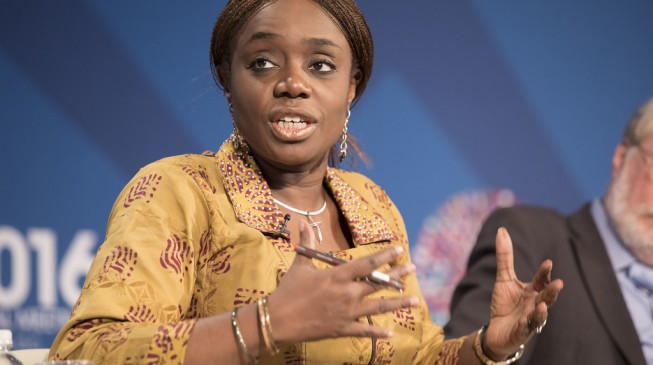
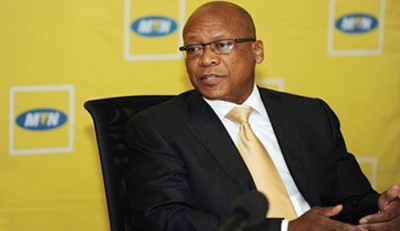
Ken Njoroge and Bolaji Akinboro, the
co-founders of Cellulant, have taken the company from a payments technology
start-up to a pan-African corporation connecting more than 40 million customers to mobile payment solutions. They were recently in Cape
Town where they jointly gave the keynote address at the third annual MasterCard
Foundation symposium on Financial Inclusion. Our
correspondent in Cape Town Mwangi Githahu caught up
with the two to discuss digital
commerce among other subjects.
 |
| Bolaji Akinboro |
 |
| Ken Njoroge |
Many people hear the words ‘digital
commerce’ and think M-Pesa. There must be more to it than that. Simply explain
what digital commerce is?
Bolaji: The
simplest definition really goes beyond M-Pesa. Because
M-Pesa originally was kind of into money transfer, [in fact] more peer-to-peer,
then later it migrated to peer-to-business (small businesses) and I believe now
it is moving into its third evolution, which is peer-to-really big businesses.
So really the idea
of digital commerce is to create an environment in which consumers can benefit
from getting what they want, when they want it and how they to pay for it. On
the other hand, businesses are empowered to connect to their consumers with
ease. Within that space they can do both virtual
transactions and transactions that translate into physical goods.
In today’s world there are things that
are purely virtual, like if you are buying airtime now, it’s a purely virtual
transaction, there is nothing physical involved with
it. But at the same time, if I wanted a taxi cab and I wanted it to come now, I
could pay for it digitally like with Uber but still get the physical taxi that
comes to fetch me.
Ken: I
think that basically gives the definition. I mean M-Pesa was just the beginning of this digital revolution so it is
not an end in itself but the starting point, a piece of service out of maybe
another seven or so that make up the broad world of digital commerce.
So do you think that this technology is what will finally give Africa an advantage over the wealthier
nations of the world?
Ken: I think so because if you look at digital payments and
that sort of thing and you look at the sort of speed that this is happening –
think about it. Fifteen or so years ago most of us
didn’t have mobile phones. But within that period of time, if you look across
Africa 500 million people have come onto the mobile phone network so they are
visible. As a result of that [sort of progress] all these narratives around Africa rising just popped up because these
numbers just leapt out of the woodwork.
What digital
does is to create efficiency in payments — because transactions are cheaper. It creates efficiency in
reaching markets and enables easy delivery of services. And not just markets, even the basic stuff that we struggle with on this
continent — getting food to everybody across the pyramid, getting water
to everyone, getting power to everyone, getting health and education to
everyone. Digital payments are completely going to revolutionise the speed, the scale and the cost of getting services to the
people and that will be transformational for the continent.
So because of
that process we get to leapfrog a lot of other stuff. We [now] don’t need to go
through the learning curve with technology. Just like
it was literally within the blink [of an eye] before 500 million
people had phones. We didn’t
need to dig up [the pavements] and lay cables all over the place. [Snaps
fingers] it just happened like that.
Can you speak of any future strategies
for the company or have one-stop payments and digital commercial services
reached their peak?
Ken: This is just the beginning.
Bolaji: We haven’t even started scratching the surface. Our own
strategic view of the future is very different from other
people. We feel that fundamentally there is what we call the bread and butter, which is
really bringing merchants and banks together within the eco-system [we are
building] — that’s really the bread and butter part. But beyond that
it’s really the market place because what we call the ‘Cellulant Mall’ which is so much more sophisticated than paper. If you
come into that mall you will find that we’ll connect everyone to everything
every day.
Give me a practical example of that. How does it work in an African context?
Bolaji: Let’s take what we call the e-wallet now. We are
connecting everyone in agriculture in
Nigeria to everyone — we are
connecting more than 14.5 million farmers to about 2,500 agro-dealers to about 115
seed companies to about 75 fertiliser suppliers, to
about three insurance companies.
So if you are
looking for someone in your neighbourhood to sell you seeds you can just get on
your phone and get in touch with whomever you need to deal with to get whatever
it is you need to get done.
So while there is the sophisticated part of our business, we
are fundamentally a people’s company.
What are the challenges and opportunities for Cellulant in
the next couple of years?
Ken: Our business is growing of course so I’ll start by looking
at that question in terms of opportunities, as that’s what drives us.
So there are
problems in the market that benefit from what we do and the experience and
expertise we’ve built. People don’t have water. The sort of problems that we
solved in Nigeria and that we are solving in other
countries still exist —
those problems affect not just agriculture, they affect power, and they affect
everything.
What’s nice
about digital payments and the services we offer in Africa is that it is not one of those things that is [referred to as] “good to do”, they are just a basic part of
the necessity of living.
Basically if
we didn’t do what we did in Nigeria, people would have starved to death. If we
don’t continue doing these things people don’t get water etc. So these services that our consumers take up are not novelties but basics
that consumers can’t do without. They are essential services not “good to do”
but necessary.
Digital
payments allow essential stuff to get to the consumers. So as long as that
continues to be true and it will continue to be true
for a while, it is basically a tremendous opportunity for us to build a great
business.
So we are not
an NGO, we are a profit business and we believe there are profits to be made in
that business of solving problems.
As for challenges, I look at them as internal and external. So
external challenges are fundamentally competition, there is also the regulatory
framework — because we are operating on the cutting edge of payments
and services, we have to continue to educate stakeholders,
regulators, mobile operators etc about some of the things we do.
That takes
time, effort and sometimes slows things down but it is a very necessary part of
things.
The other
challenge is obviously the competitive environment. As it becomes clear that there are opportunities to build billions of dollars in
terms of businesses, it attracts competitors. So we find ourselves competing
with companies like us that operate only in specific countries, others like
us who operate across multiple countries and sooner
or later some of the larger global businesses will get into the fray. So
competition is a big challenge that we need to keep dealing with and we deal
with it by being very agile and very nimble. Also, most
importantly, we really have experienced and
understand these problems.
On the
internal side, I think the biggest challenge we have is the question of
how we build talent and find talent to match the growth of the business. I
think today that is our single most important challenge and we are spending a lot of time figuring it out.
Think about
it. Over the last 13 years or so that we’ve been in business, we’ve grown
from a staff of three to a staff of 250 people. Into the next year I think we
are going to hire somewhere between 70 and 100 people.
It’s very possible to imagine that we are going to sustain
hiring almost 100 people over the next three to four years.
These [new]
people are going to come prepared to work the way we do, which is to
work with a high level of ambition, working tirelessly to make things work etc. That is certainly a big challenge.
Both of you were in a different field of knowledge before
you got into business. You were pharmacists I believe…
Ken:
[Laughing] I’m a dropout pharmacist and he’s a
graduate.
Bolaji: [Also laughing] He’s a dropout pharmacist and I’m a complete one.
When did you make the switch? What led to the ‘light-bulb moment’ occur for you on the subject of digital
commercial services?
Bolaji: Well,
how the practice works in Nigeria where education is free is that when you leave university you must do two year’s
national service to repay the government for your free education. I went to
public schools all my life and so I had to do a year’s internship where they
made sure that all I learned in university was still
in my head.
So for me in
particular, I worked in a the Swiss pharmaceuticals company Roche, did a tour
of government where I worked in a government hospitals and did a tour of
community pharmacies where I was the guy at the local community pharmacy.
I was still fresh from university but I knew a bit about life
by now and my conclusion was that being a pharmacist in Nigeria was the same as
being a teacher. Not that there’s anything wrong with being a teacher but when
you are a teacher your reward is in heaven and since
I was more of a commercial character…
Ken:
[Laughingly interjects] You wanted your reward on earth.
Bolaji:
[Laughing] Yes. I wanted to enjoy the rewards when I was still here. So I
decided to find something else to do with my life. It just so happened that Proctor and Gamble came to orientation
camp for the National Youth Service and on reading one of their flyers, I decided to
go and see what these guys were all about.
At Proctor
and Gamble, I met an Egyptian guy who told me that at the firm I would learn nothing in particular but instead a bit of
everything. But most importantly, he said, I would learn how to develop a
strong character and how to just find your way through life. I found those
statements intriguing and decided to try working
there and that’s when my life took a detour.
What about you Ken? What made you drop out of pharmacy?
Ken: I think the light bulb moment to get into technology
happened before I went to pharmacy school when I went to Strathmore University
where we were some of the pioneers of their computing
college.
So before I
went to pharmacy school I did some time at Strathmore and I fell in love with
computers. It’s just that simple.
Then when I
went to pharmacy school it became very clear that this typically was not my thing. I didn’t feel as much passion for it and so I
quit.
If you could go back to 2004, when you started your
business, knowing everything you know now about the business, what, if
anything, would you do differently?
Ken and
Bolaji: We’d never start it! [Laughter]
Ken: I know people like to give these nice political statements
to questions like this, saying things such as we’d do nothing differently because
the hard lessons were great lessons etc but looking back with hindsight, we’d
not start it.
Surely it
can’t be that bad, you’ve made a success out of this venture…
Ken and
Bolaji: It is that bad.
Ken: Don’t sugar-coat it. I know this is not the answer you
expected but man, we’d just not start it, but having said that the journey has
been unlike any other. Today I think as characters
and as individuals, we have been through just so much. There is nothing under
the sun that we haven’t seen.
Nevertheless,
generally when you look at it that way and see how far we’ve come, there’s no
other path — at least for me — that would
have yielded the same outcome. It has made me the person I am, the executive I
am.
Was
financial success your main goal or was it the innovation
that drove you?
Bolaji: The formation of this company had really nothing to do
with money. Because most people now might think we are in this to make a lot of
money.
We were just
intrigued by a problem in our society. By simply asking look, where are the companies in Africa started by regular people who
came from normal backgrounds? People who did not have rich fathers or uncles or
know political godfathers?
We wanted to
be a company started by regular people and today you can find regular people who will say, yes, I was there when these people started and
theirs is just a story of building it piece by piece.
Such stories
are few and far between but we said it is possible in Africa for regular people
to get a company going and grow it into a pan-Africa
business. I guess if we knew what we know now perhaps we might have found other
dreams, but that was our real motivation from the beginning.
We always
wanted to start businesses in many countries, even when those businesses were
not viable, but we felt it was and we have shown it
is possible to build a pan-African business.
What drives you? Cellulant is out there
and people are looking at it and wanting to emulate it. What advice would you
give them?
Ken: I think there needs to be a motivator other than money. Money is always as a result of the pursuit of
that motivation.
Bolaji: This question that you ask is very interesting because
there are guys
whose business model is to find their way to meetings like these, do you
understand what I mean? That is their business model,
they believe too much in networking.
But we’ve not
had that story. Like Ken said, it can’t only be money that drives people. I
think if I were to advise anyone I would tell them: You know what? You need to
find a human problem or a human need that only you
can solve. And then you need to see yourself as the person that can solve that
problem and not give up until that problem is solved. I think that’s how we
would summarise it. Because right from the word go, we wanted to build a company like this, but we’ve gone through different routes in
different markets to reach the ultimate end point that we sketched out many,
many years ago.
From the sound of it, you
guys are very focused and very driven, but in your down time what do you get up to? Do you even have down time?
Bolaji [laughing]: For me I don’t understand that concept at all.
Ken: We really enjoy what we do and so for me the concept of
relaxing or going on holiday or take time off work…I mean…Look at me now in
Cape Town at a conference. I feel like I’m on holiday
just enjoying what we do.
Bolaji: Like this trip to Cape Town now, is like a holiday for me.
I mean it is work, but it’s just like a holiday.
Ken: We like to work but of course we are also family men. So
in my case, my life is just a
dichotomy — I’m either at work or
with my family and that’s it. I don’t drink, I don’t go out, I don’t play golf
but I’ve taken to walking recently.
- See more at:
http://www.the-star.co.ke/news/its-possible-regular-people-build-pan-africa-business#sthash.RzEKwaHd.dpuf
Source:
http://www.the-star.co.ke/news/its-possible-regular-people-build-pan-africa-business
Posted by Ike Onwubuya