Showing posts with label Oil and gas. Show all posts

Thursday, 6 October 2016

It is hypocritical to block us from using coal-fired power- Nigeria's Finance Minister tells western governments

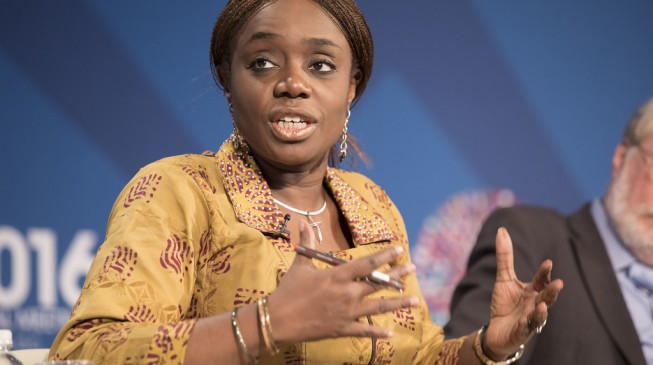
Minister of Finance, Mrs Kemi Adeosun yesterday described as hypocritical efforts by the western government to stop Nigeria from using coal-fired power to power their industries when in fact it is the same coal-fired power system that has helped countries like Britain achieve the kind of industrialization it has now.
Speaking at the International Monetary Fund (IMF) discourse on infrastructure in Africa ‎at the George Washington University USA, Adeosun frowned at the recent blockage of a coal project to Nigeria by some Western powers.
“The case, if you look at the numbers of business cases in Africa, is quite a huge one. Yes, we do need macroeconomic stability. We also do need consistency of policies by the multilateral institutions and western countries. Let me give you an example. In Nigeria, we have coal and it doesn’t take a genius to work out what it will take to get coal-fired power. Yet, we are being blocked. I think there is some hypocrisy in that. We have an entire western industrialization that was built on coal-fired energy and that is the competitive advantage that has been used to develop Britain, where I grew up. Now, Africa wants to do it and they saying it’s not green, we can’t do and that we should go and do solar, wind, which are the most expensive power projects. The West cannot say that after polluting the atmosphere for 100 years, and when Africa wants to explore its resources, they say no. If we want to stop coal, those who started it over 200 years ago, should first stop using coal before telling us to stop”‎she said

Friday, 24 June 2016

Nigeria looks to coal,solar and biomass to achieve national energy security

The Minister of Power, Works and Housing, Mr. Babatunde Fashola, has said that the Federal Government is increasingly looking to alternative sources such as coal, solar and biomass for power generation in a bid to achieve national energy security.
He said the 700-megawatts Zungeru hydropower project would soon be completed, adding that construction of the 3,000MW Mambilla hydropower plant would commence shortly.
Fashola, who spoke at an annual lecture organised by the Nigerian Institute of Electrical and Electrics Engineers in Lagos on Thursday, noted that the nation had over the years relied heavily on natural gas for power generation.
The nation’s power generation and supply have dropped significantly in recent months on the back of the resurgence of militant attacks on oil and gas facilities in the Niger Delta.
Fashola said, “Our vulnerability to gas has become apparent to the development that we are seeing. And so, one of the things that the energy mix will do is not just taking power plants closer to fuel sources, but to also help in achieving national energy security. So, we are going beyond solar to coal and to a lot of hydro.
“We will soon finish hydro power plants like Zungeru and start the biggest hydro power project, the Mambilla, which will give us in one place about 3,000 megawatts. We are finalising the procurement now.
“We will use biomass because there is a sugar processing plant and sugarcane plantation somewhere in Adamawa, and we are talking to the proprietors to see how we can use some of that also for producing energy.”
Beyond power generation, the minister said it was important to engage electricity consumers on the demand side management, also known as energy conservation.
The minister added, “Beyond all of this generation of power, what is important is the demand side management, which we have come here to talk about, which is energy conservation. There is capacity to conserve between 1,000MW and 2,000MW by actions that all of us should take in our homes, in our offices, the way we build, the way we use energy.
“We have seen that air-conditioning and kitchen equipment constitute the largest consumer of power. So, how we build our houses, how we use less of air-conditioning, how we air our homes using nature, more wind, working with our architects, how we shape and situate the angle of our house so that we conserve less energy, how we use less water by being efficient in conserving water to transfer energy to cost.”

Friday, 26 February 2016

Oil firms’ cash flows worsen, banks jittery


Femi Asu
Nigerian indigenous oil and gas firms are recording negative cash flows as the plunge in global oil prices lingers, a development that has sent shivers down the spines of many banks.
Nigerian banks have in recent years increased their exposure to the nation’s oil and gas sector, providing financing for asset acquisitions and development by indigenous firms.
Industry players, who spoke at the 13th Aret Adams Annual Lecture Series in Lagos on Thursday, lamented that the low oil price had severely affected their operations, leading to huge cuts in capital expenditure and affecting their ability to repay loans.
The Managing Director and Chief Executive Officer, Seplat Petroleum Development Company Plc, a major Nigerian independent oil and gas firm, Mr. Austin Avuru, said, “Exploration and production companies are now constrained. I think the banks are more nervous than the operating companies in Nigeria.
“We saw a profit warning yesterday (Wednesday) from First Bank describing impairments that are likely to erode their P&L bottom line when they publish their 2015 results. That is a warning to shareholders and investors and that is because of their exposure to the upstream segment of the oil and gas industry.”
He said exploration investments had almost dried up, adding that the implications would become evident later as addition to reserves would flatten out.
Avuru said, “When people ask me how we are doing, I say we are under water. If you can survive at the end of 2017 under this regime, you will be in business for all time. I suspect that there will be a lot of dead bodies by the end of 2017.
“The biggest problem with the independents is that we are all heavily leveraged. You borrowed to buy our assets. You borrowed to work the assets, and deployed critical capital expenditure so that you can ramp up production; so that you can repay your debts. Then came the drop in price. You cannot grow production because you don’t have the free cash flow to do that. You need production, even more production in this price regime.
“So our biggest problem is our discussion with our bankers. Most of us are now cash negative. As I said, you need more cash to do investment to grow oil production to be able to meet your obligations and that is exactly what you don’t have. For the majors, usually what they need to do is cut capex, fire some employees to balance their books and explain to their shareholders why they are reducing marginally the dividend payout.”
Avuru said the service companies had been hardest hit, adding, “57 per cent of the land rigs in Nigeria today are idle. Each of these will ordinarily be employing some 210 people. In 2013, we were operating seven rigs in Seplat, we dropped our last rig in November 2015. We don’t have a rig working for us now. Service companies are in serious trouble.”
The Managing Director and Chief Executive Officer, Chevron Nigeria Limited, Mr. Clay Neff, who described the drop in oil prices as dramatic by any scale or stretch, said, “We are going through challenging times. Development work has dropped significantly. New projects are being slowed down because the economics don’t justify going forward.”
He stressed the need to address the funding challenge facing joint venture oil and gas assets in Nigeria, putting the cash call arrears owed by the Nigerian National Petroleum Corporation at over $5bn.
Copyright PUNCH.
All rights reserved. This material, and other digital content on this website, may not be reproduced, published, broadcast, rewritten or redistributed in whole or in part without prior express written permission from PUNCH.
Sunday, 25 October 2015

Oando records N179b loss in 2014

Oando Plc announced a loss after tax of N179 billion for the financial year ended on December 31, 2014.
The News Agency of Nigeria reports that this is against the backdrop of a profit after tax of N4.68 billion posted in 2013.
This was contained in a statement released by the company in Lagos, a copy of which was obtained by NAN.

It said the company recorded a turnover of N424.68 billion compared to N449.87 billion recorded in the corresponding period, 2013.

The statement added the company for the six month ended on June 30 declared revenue of N60.32 billion against N55.67 billion posted in the comparative period in 2014.


According to the statement, the loss after tax stands at N34.68 billion in contrast with the profit after tax of N5.74 billion achieved in 2014.
The statement quoted Wale Tinubu, the Group Chief Executive Officer, as saying that the company would bounce back into profitability in 2016.
It said the company’s profit after tax numbers were impacted by impairments of N76.9 billion in exploration and production, N16.9 billion in under lift and N7.3 billion foreign exchange losses, among others.
The statement said appropriate consolidation of Oando’s subsidiaries’ accounts and painstaking due diligence undertaken as a result of the magnitude of impairments contributed to the delay in the release of its accounts.

It said: “Upstream players have been forced to record significant reductions in the fair value of their asset portfolios.
“Oando is no exception to this global trend, which has led us to recognise about N76.9 billion of impairment charges in our exploration and production business.”
The statement also said the impairment was due to lower oil prices leading to a reduced valuation of certain exploration and appraisal assets.
It said: “The nature of the business makes us extremely vulnerable to foreign exchange risks as we import in dollar denomination and recover our costs in naira.
“The delay of payments of subsidies from the Federal Government has served to increase this vulnerability and led to a realisation of N7.3 billion in foreign exchange losses.”
NAN.

Culled by Ike Onwubuya
Source - http://theeagleonline.com.ng/oando-records-n179b-loss-in-2014/

Latest News

Stock Markets News